

* The Weekly Month’s Wrap — the most important, impactful and interesting news stories, ideas, cultural trends or just plain-old fun and oddball items I found this week month.
The Weekly Wrap returns — after a long several weeks of breaking, history-making news. If you follow regularly, you know that I haven’t been able to sit down for my usual week-end recap since news broke on marriage equality advancements in mid October. In the four or so weeks since, I’ve been slammed as news on the marriage front and other breaking events, like the election early this month, kept me busy. We get back to my regular recaps this week, though, as noted above, it’s more like wrap and personal reflection on the preceding month’s…
Marriage madness
No one saw it coming. Not me. Not local or national advocates. Not the plaintiffs involved in the several cases in North Carolina or South Carolina.
Everyone I had spoken to or followed on the issue had expected the U.S. Supreme Court to take up at least one, if not more, of the marriage equality cases bubbling up from the circuit courts of appeal.
But that didn’t happen.
On Oct. 6, the U.S. Supreme Court declined to hear several marriage equality cases on appeal from lower circuit courts. One of the cases was Virginia’s Bostic v. Schaefer, decided by the Fourth Circuit Court of Appeals earlier this year, when judges struck down Virginia’s anti-LGBT marriage ban.
The high court’s refusal that Monday to hear Bostic and the other cases had the immediate effect of upholding the decisions laid out by the circuit courts. At 1 p.m. that same day, Virginia began issuing marriage licenses to same-sex couples and a frenzy swept into other states in the circuit — West Virginia and the Carolinas — which hadn’t already opened their doors to marriage equality.
I found myself sitting on edge, waiting for news of action from North Carolina’s federal district courts. Finally, right before close of business on Wednesday, Oct. 8, movement came. I was driving back to the office from an errand and, while stopped at a traffic light, I quickly checked into Twitter.
“Court has issued an order,” the tweet read, with no other details.
I got back to my office as quickly as I could, parked and jumped out of my car, ran through the parking lot and into the building. My computer already shut down for the day, I commandeered my production director’s work station. No details of the order had yet made it out to the masses, so I logged into the court’s filing system and downloaded it, quickly read through it and printed it out before heading back out the door and into my car again.
In Uptown Charlotte, gay couple Scott Lindsley and Joey Hewell had decided they would anxiously wait out the forthcoming ruling at the Mecklenburg County Register of Deeds office. I drove down to meet them and we discussed Greensboro federal court Judge William Osteen’s order — a routine move simply lifting a previous stay on the cases before him and allowing court proceedings to begin again.
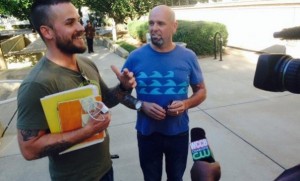
The order on Wednesday wasn’t ground-breaking, but it gave Scott and Joey some hope, finally allowing them to move closer toward their legal marriage than they’d ever been allowed before. Mecklenburg Register of Deeds J. David Granberry — a defendant named in a similar case filed by the United Church of Christ, clergy from other faith traditions and several couples — must have known the writing was on the walls. That afternoon, he allowed Scott and Joey to begin the process of filling out a marriage license application, with just one catch: Granberry wouldn’t process it until a final order was issued overturning North Carolina’s anti-LGBT amendment.
The Wait: Thursday
Joey and Scott decided they’d return to the courthouse office complex the next morning, hopeful, as I was, that a final ruling would be issued sometime on Thursday, Oct. 9 — one year to the day that Joey and Scott, as well as other local couples, had requested and been denied marriage licenses from Granberry’s office in a Campaign for Southern Equality action.
The next morning, Joey, Scott and I were joined by a small group of other community members and supporters, local media and advocates. Photographers Jennifer Hogan and Grant Baldwin — two of many who came to document the history and later allowed QNotes to use their photography in our reporting — joined us, too.
There wasn’t much in the way of new advancements to report. I spent part of the early morning following up on Wednesday’s earlier advancements down south. A judge in Charleston, S.C., had allowed local, openly lesbian elected official Colleen Condon and her partner to apply for a marriage license. Quite humorously — confirming every stereotype about the South and our large families — the local judge, Irvin Condon, turned out to be Colleen’s distant cousin. The couple had hoped to receive the license that Thursday morning, but the South Carolina Supreme Court had halted those plans late in the evening on Wednesday.
I checked in occasionally on social media and refreshed the online court filing system for new orders and advancements. Many thanks, by the way, are owed to the good taxpayers of Mecklenburg County, upon whose publicly-funded wi-fi and power outlets I came to rely those days at the courthouse.
Advocates and observers had expected, or at least hoped, for a decision from Osteen on Thursday. One had told me the judge had worked late in the evening preparing his order. Here at home, the United Church of Christ’s case seemed to languish. No news of advancements there, either.
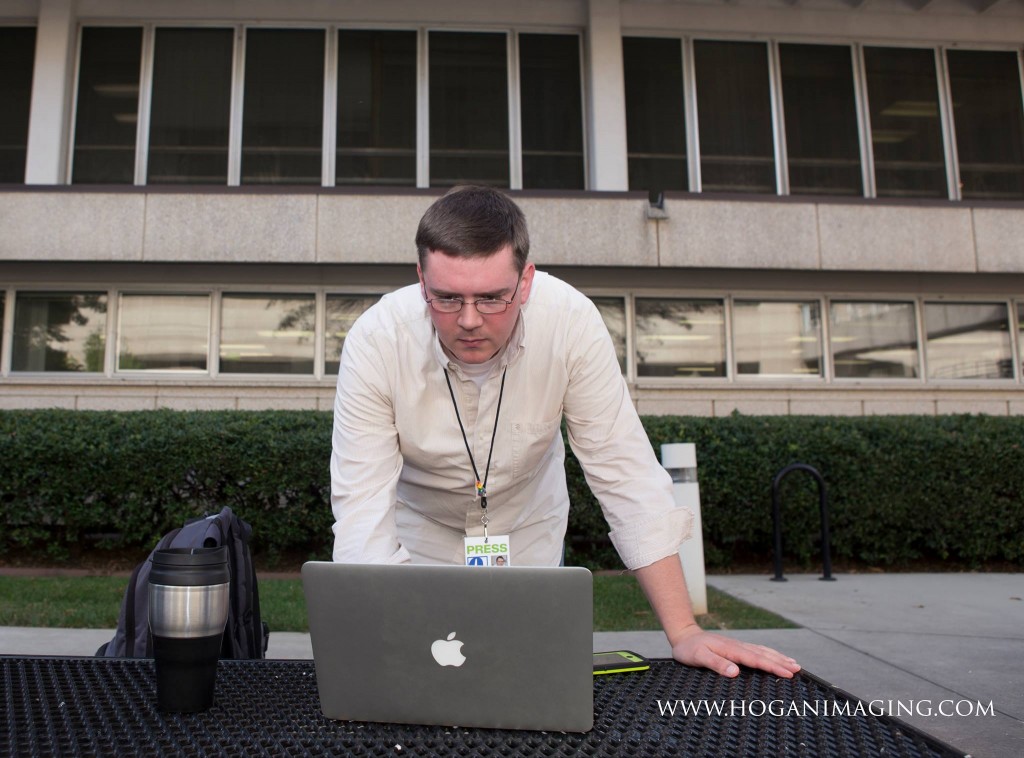
In the mid-afternoon, it became apparent no positive, forward movement would happen that day. Osteen asked any interested parties to submit any necessary motions by close of business. Republican legislative leaders filed to intervene.
Later that evening, I’d reflect on the day in a report at the newspaper. “Ruling seemed imminent,” I’d write in a subhed, a feeling carried over by media onlookers and advocates the next day.
The Wait: Friday
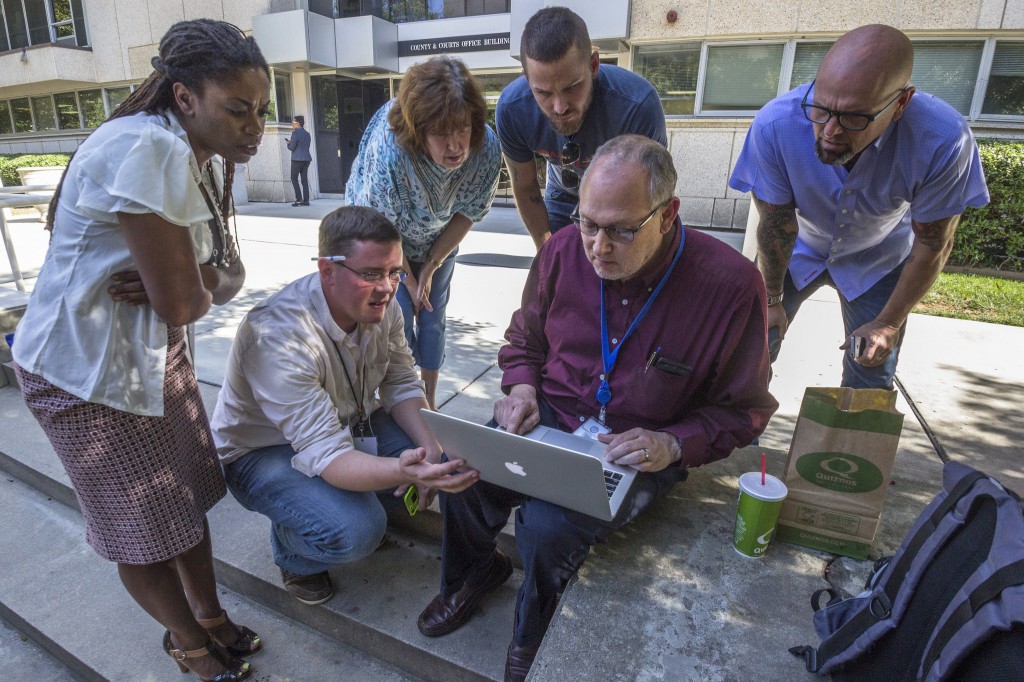
I didn’t make it to the courthouse until about 11 a.m. on Friday. Osteen had given the Republicans until noon that day to file a proper response, after failing to complete their motion appropriately the day before.
Still, a feeling of imminence on a potential ruling was palpable.The old cliche, “Hurry up and wait,” was about all you needed to describe the day, though.
The media gaggle had grown, with every local TV station and nearly every local newspaper now represented at some point during the day. Jennifer and Grant joined in the media fray again.
Equality North Carolina had two staffers — Crystal Richardson and Matt Hirschy — out on Friday. Other local leaders and community members —RAIN’s Debbie Warren, state Sen. Jeff Jackson, MeckPAC’s Larry Ferri, attorneys Connie Vetter and Sarah Demarest, the LGBT Democrats’ Cameron Joyce, among many others — came out, too.
And David Granberry, Mecklenburg’s register of deeds, calmly and cooly plodded along with the frenzy, stepping outside of his office to update community members and media as further motions were filed and rumors swirled.
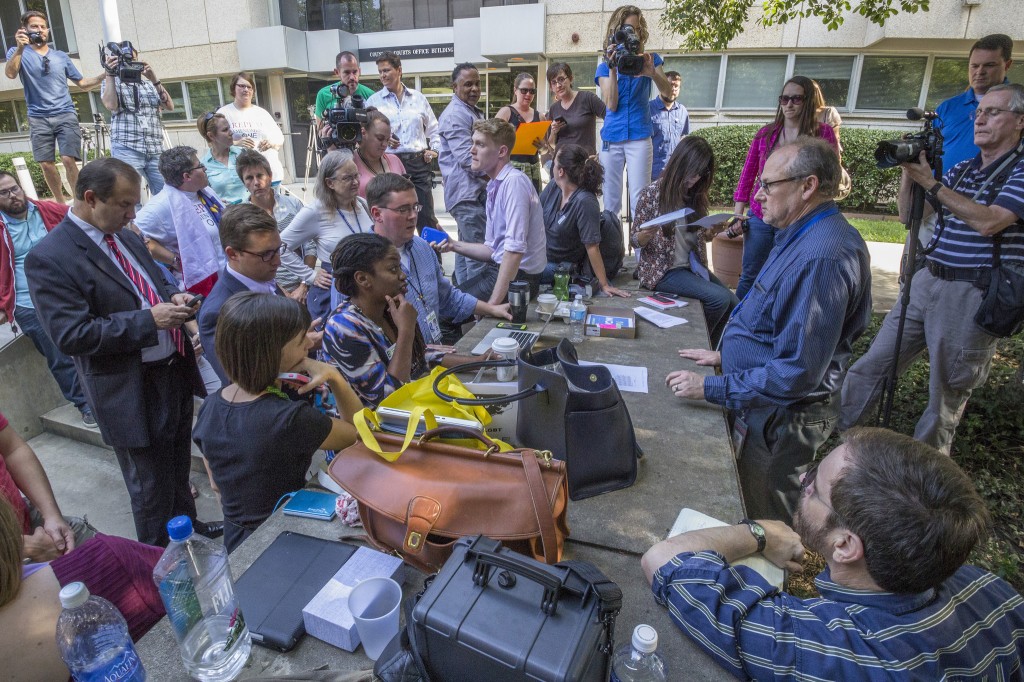
By 4 p.m. that Friday, it seemed the previously-felt imminence was in vain. No order had come down from Osteen and Western North Carolina’s United Church of Christ case now in front of Judge Max Cogburn had still be quiet.
Osteen dropped another order shortly thereafter, denying Republican requests for oral arguments and giving parties in the cases until the following Monday to present additional briefs.
“No ruling issued today,” read part of my headline, as community members and media began leaving the courthouse.
Earlier in the day, Joey and Scott, along with a few other couples and Equality NC’s Crystal and Matt, had urged Granberry to keep his office open late, in case an order came down. Granberry had said he didn’t have the authority to do that. Still, he stayed behind a few minutes after close of business — right has unexpected news broke that Cogburn had issued an order striking down the anti-LGBT amendment.
Like news of the Supreme Court’s inaction on Monday, Cogburn’s movement late Friday afternoon was a stunner.
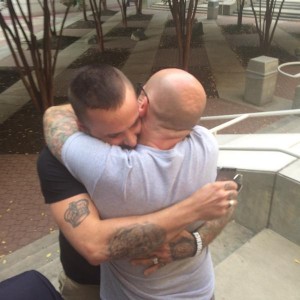
The media outlets that had left came rushing back — interviewing Joey and Scott, the only couple left on the scene, about their reactions after the two shared an emotional, celebratory hug on the steps of the courthouse office building.
While Charlotte was quietly, patiently waiting it out, dozens of couples each in Greensboro, Raleigh and Asheville had begun to line up as early as Thursday, repeating their anxious anticipation on Friday. Registers of deeds there either remained open or rushed to reopen their offices and process couples’ marriage license applications.
The Weekend
I spent the weekend processing stories and updates from the exciting action in Greensboro, Raleigh and Asheville. Dozens of couples had received their licenses and married, among them a deputy with the Wake County Sheriff’s Office and his partner, also an employee in the office. In Greensboro, Equality North Carolina’s executive director, Chris Sgro, married his longtime partner Ryan Butler.
On the legal front, I kept tabs on the GOP’s continued efforts to defend the ban, their hired anti-gay lawyers and doubts over a local register’s attempts to hold off issuing licenses come Monday morning.
I’d wanted to take time to rest that weekend, but ended up spending most of writing and researching. On Sunday, I finally had the time to experiment with a solution that would allow the newspaper to live stream its coverage of the forthcoming history-making Monday. I went to bed early, anticipating a full day of work.
Twenty Hours
I woke up early in the morning on Monday, Oct. 13, checked in on my email, social media and other updates and somehow, despite still being so tired from the week before, managed to get out of the house before the sun rose.
I got Uptown right after 7 a.m., a couple water bottles, a few Nutri-Grain bars and my big travel mug of coffee in tow. First silently and then to friends, I grumbled about the courts’ timing and the weather. Unlike the last week’s sunny, comfortable weather, Monday morning brought grey skies, a drizzle and fog — dampening my clothes and equipment, with the attendant humidity constantly fogging up my glasses.
But the weather hadn’t stopped at least a half-dozen couples who’d already lined up at the Mecklenburg Register of Deeds office. More continued to show up, taking their place in front of the locked office doors.
Again, Jennifer and Grant joined in to visually document the day. Cameron Joyce had returned, this time in a friendly assist to me and the newspaper. He spent the minutes before the marriage license office opened speaking to couples and gathering their stories.
At 8 a.m., the doors were opened. The couples and the crowd gathered to support them erupted in cheers.
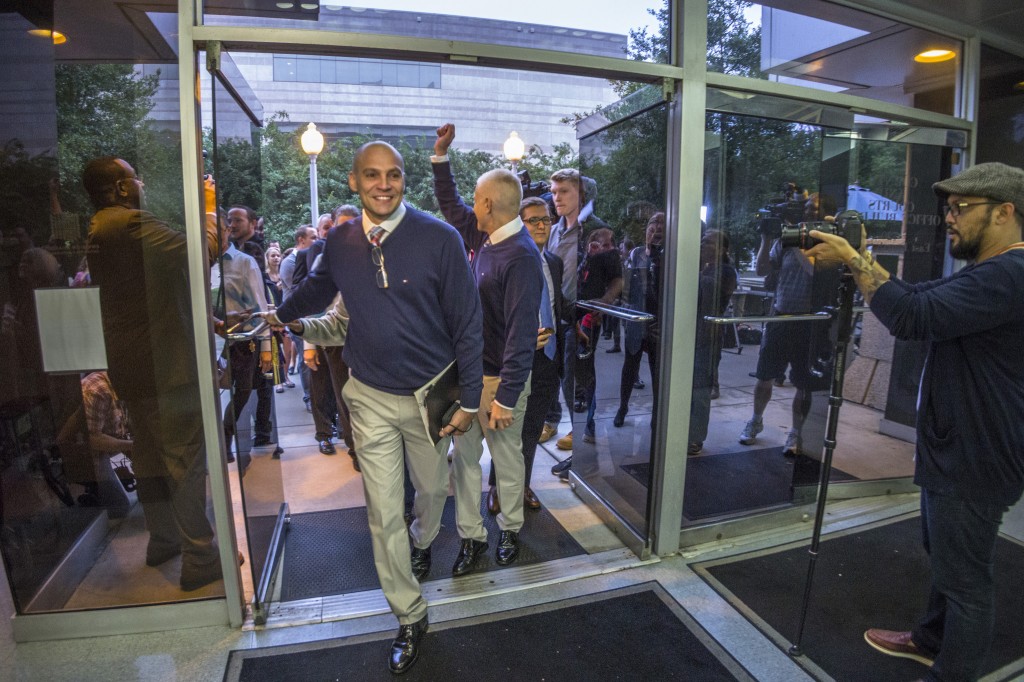
Once inside the office, happy couples raised the hands and swore their oaths before receiving the marriage licenses. I wanted to cry tears of joy with them, but remained focused on work. The first couples in line had barely finished the application process when a young straight couple walked in the door — visually dazed and surprised at the crowd inside the usually quiet, composed government office.
Outside, the Charlotte Pride Band played a medley of “Going to the Chapel of Love” and Felix Mendelssohn’s traditional “Wedding March” as each couple — including the two young straight lovers — exited the office.
The day played out smoothly — with angry words and tantrums from two outspoken anti-gay protesters the only interruptions.
Cameron continued to gather stories throughout the day. Later that evening, we both attended a community-wide, interfaith celebration. More than 200 people showed up at Holy Trinity Lutheran Church. As I took notes inside the sanctuary, Cameron slipped away to work. Afterward, we headed to Plaza Midwood’s Common Market, where we stayed until they closed at midnight, finally wrapping up Cameron’s phenomenal multimedia photo essay.
I headed home to wrap up my own stories and recaps, to be published the next morning. I finally wrapped up my work sometime around 3 a.m., hopping in bed after an exhilarating 20 hours of work that day.
The work continued the next day and several more, as more and more couples wed across the state and the Republicans continued their legal temper tantrum.
But what struck me most then, as it still does today, about those precious few history-making days was just how personally powerful it was to me and to everyone else gathered to witnessed the advancements first hand. The couples. The activists. The leaders and supporters. Members of the media. All of us had invested so much time, energy, emotion and anticipation in the work toward that one small moment when the register’s office doors swung open and cheers, laughter and tears came flowing from couples rushing inside.
Moments like these are rare and fleeting, but their sheer emotional power is overwhelming even now a month later. I imagine I’ll look back fondly on these memories in future decades with the same sense of awe — amazed that history turned so quickly, amazed that it took so long to recognize the inherent humanity and equality present in every committed, loving relationship.
While a break to celebrate a hard-fought success is both healthy and deserved, we can’t pause for too long. The movement we’ve built — the resources gathered and expended — to reach this milestone can’t go to waste. Those resources and the empowerment we feel from this most recent, remarkable string of victories can push us forward into more necessary fights for fuller equality — in employment, in healthcare, in housing, in the criminal (in)justice system.
