
Over the weekend, the Society of Professional Journalists updated their Code of Ethics. It was a long time coming — the last update had been made nearly two decades ago.
The core of the code remained unchanged, including calls for journalists to be the “voice for the voiceless” and, in tandem, “seek sources whose voices we seldom hear.” The entirety of the code is near to my heart and my work — as it should be for any journalist. But, these two points guiding us toward diversity and justice have certainly resonated strongly with me.
As someone who has worked with a niche, LGBT community newspaper, I have a keen understanding of the importance of giving space and place to voices often overlooked and sometimes outright ignored. It’s precisely because of that ignorance of our community that intrepid pioneers began publishing their own LGBT community news publications beginning in the 1950s. It’s why my current employer QNotes along with predecessors and counterparts like the Charlotte Free Press, The Front Page, Carolina Lesbian News and Out in Asheville were begun here in North Carolina beginning in the 1970s.
When mainstream media ignored our very existence, LGBT community publications filled the void. When mainstream media mentioned us only in the context of crime and sin, LGBT community publications filled the void. When mainstream media offered no space for our community to connect, to grow and to learn, LGBT publications filled the void.
Even now, as mainstream media grows increasingly willing to cover LGBT-related news and human-interest stories, LGBT community publications still have an important role to play. We still connect our community in ways larger, daily newspapers or TV news stations can’t. We publish the successes and achievements, trials and tribulations of community members and organizations that might otherwise fall off larger publications’ radar.
Yet, even LGBT community publications aren’t perfect.
Niche community publications — those folks assume are the closest and most connected to the communities they serve — also miss important news. We, too, can overlook crucial, compelling and often-overlooked stories that, in the words of the Society’s Code of Ethics, highlight the “diversity and magnitude of the human experience.”
This shortcoming is natural in any publication, but it’s one each and every journalist — whether at a daily newspaper or one like QNotes — is obliged to investigate, question and improve. I’m glad to say my colleagues and I at QNotes have been doing just this over the past several months.
Last year, for the first time in nearly a decade, QNotes rolled out an in-depth reader survey with dozens and dozens of probing questions exploring a variety of reader demographics, habits, wants, preferences and behavior. The resulting survey data was compelling; we made a variety of immediate changes and others we integrated into this year’s editorial calendar. The data was also revealing — showing us we’d missed key demographics among our readership and exposing gaps in our own coverage of the community.
Like mainstream media, we had allowed ourselves to become ignorant to some, ultimately to the detriment of all.
Our survey showed we had a tremendous gap in two key reader demographics — women and the African-American community.
We knew we had to do better.
We asked around. We chatted. We took advice and important, essential feedback and criticism.
“No one here picks up your paper,” someone informed us. “There’s never anything in it that interests us.”
It was hard to hear. Hard to digest. But, it was necessary.
In the fall, we updated our mission statement. We knew that if we wanted to reach these two key reading communities, we’d have to broaden our scope and begin to cover issues and topics important to their daily lives. We’d spent nearly three decades covering news, art, entertainment and more on LGBT life. Now, we strive cover social justice issues, too — like poverty, employment, health care and criminal justice issues and more.
We took a hard look at the people and sources upon whom we relied for the bulk of our news. We found it primarily male, primarily white. The feedback had been true — we weren’t providing voices for the voiceless and we weren’t seeking out voices seldom heard.
Though there’s still much more work to do, I can look back on months’ worth of work and see that we’ve made several important steps toward change and inclusion — not only in an effort to close the gap in our reader demographics, but also to more broadly highlight that important job of sharing the “diversity and magnitude of the human experience.”
We began to feature the voices of more women and people of color, along with new focuses on other communities and issues of importance, in our news coverage and A&E/Life&Style features. Our regular, casual Q&A column, “Our People,” was diversified. Since last fall, we’ve featured several women, members of the African-American and Latino communities and a transgender leader.
At the same time, in keeping with our new mission statement’s addition of social justice issues, we reported on employment issues endemic to people of color and transgender people, a story on LGBT immigrants, a cover story exploring body and sex positivity with a diversity of community members and a cover story prompted by the daring bravery of a young trans woman who stood up against discrimination. We took on probing criminal justice issues, like legal questions that arose after the arrest of a man charged with statutory rape. We took on sharing the story of a small business versus corporate interests. Our sit-down interviews with Charlotte’s mayoral candidates last fall included questions on LGBT equality, as well as broader questions on economic development issues and community and neighborhood issues.
Our editorial calendar was also designed to be more inclusive — with scheduled features and cover stories on local black LGBT nightlife, a diverse young professionals issue and a two-part series on local women’s history in the LGBT community. Cover photos for other stories were composed with an eye toward intentional inclusion.
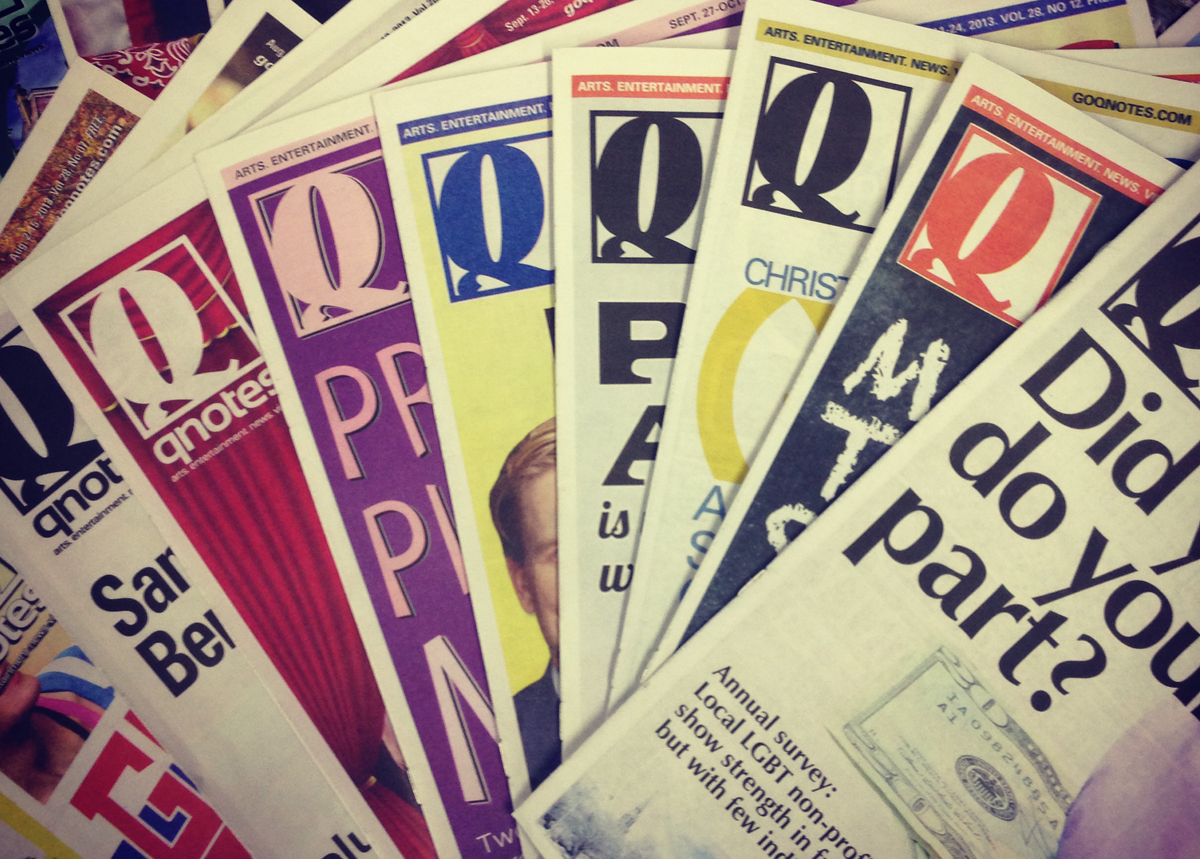
The result? QNotes has featured more women, more people of color, more diverse topics of community life and news on our covers (take a quick peak in our Issuu.com archive) and in the interior of our publication in the past several months than in almost the entire time I’ve been editor.
I told one community leader last fall to give us another chance. “Keep an eye on what we do over the next several months,” I said. “Hold us responsible if we fail.” With that promise in mind, we’ve labored to improve. I know we have a lot more work to accomplish. Our drag community, for example, is clamoring for better representation and inclusion. And, we’ll make efforts to improve our coverage.
All in all, this process toward better inclusion and fair representation has been nothing short of an eye-opening, soul-searching, educational endeavor. I’ve learned more than I could have ever imagined, met unique leaders and community members essential to the community’s strength and health and, most importantly, drawn closer and more committed to the principles which have kept QNotes thriving for nearly 30 years. We are giving voices to the voiceless. We are seeking sources seldom heard. And, I’ll continue to strive toward better perfection in this regard and in every other point exemplified by our journalists’ “creed” — our code of ethics.
Most importantly, though, I’ve learned that feedback and constructive criticism is essential. Of course, we all think we know this. But, actually putting it to the test and holding yourself to a committed promise and standard really does put you face-to-face with your own integrity. Do you really like feedback? Are you really willing to listen to readers’ criticisms? At QNotes, we have been listening, and I couldn’t be more grateful for those who offer their valued opinions and criticisms to us on a daily basis.
